
RCC Release and Transfer Paths
Roederer Correctional Complex is an active medium-security Kentucky Department of Corrections institution. A person may leave on parole, mandatory reentry supervision, conditional discharge, or expiration of the custodial sentence. Each label carries a different legal result. Parole and mandatory reentry place the person outside the prison under continued supervision. A discharge entry may still mention a detainer, which warns that another agency can take custody.
A move from RCC to another Kentucky prison is not release. KOOL, the Kentucky Offender Online Lookup, shows the current location and status. The state's Daily Releases archive identifies the DOC number, name, type of release, and “Released From” institution. Read both sources. A new prison location points to transfer, while a daily report entry with an exact release type documents the state event.
| Record | Read first | What it establishes |
|---|---|---|
| KOOL | Status and current location | Custody or community supervision |
| Daily Releases | Type of Release and Released From | Dated DOC release event |
| VINE | Event wording and date | Change reported by its source |
| DOC file | Certificate and status history | Durable agency record |
Confirm RCC Release Records
Search KOOL with the smallest reliable set of fields. Last name and first initial can prevent an incorrect extra field from hiding a valid record. Add the PID or DOC number when known. Compare all matches, then open the detail result. The Oldham County release-record search explains how county and state custody sources differ.
- Match the full name, PID or DOC number, and physical identifiers.
- Read status, location, institution start, and supervision category before sentence history.
- Open the Daily Releases report for the suspected date and search “Released From” for Roederer Correctional Complex.
- Match the DOC number, then preserve the report's exact type-of-release wording.
- Use VINE for a second event check and request DOC records when formal proof is needed.
KOOL may show a minimum expiration date, parole eligibility date, and maximum expiration date. These are not interchangeable. Parole eligibility only marks when consideration can become possible. A projected or minimum-expiration date can change with credits, new judgments, forfeitures, warrants, detainers, or parole action. Only an actual event record confirms what occurred.
RCC Release Records Contact
The institution contact can help identify official routing, but a written DOC request is the right route for an existing release or discharge file. Ask for a defined record instead of asking staff to calculate a date or give a legal conclusion. Useful descriptions include the offender identification sheet, sentence-calculation sheet, release or discharge entry, release certificate, parole certificate, final-discharge record, and KOMS status or location history for a set period.
Roederer Correctional ComplexP.O. Box 69
La Grange, KY 40031
502-222-0170 or 502-222-0173KY DOC Open Records Coordinator
Division of Public Affairs
P.O. Box 2400
Frankfort, KY 40602
correctionsopenrecords@ky.gov
Fax: 502-564-9575
Include the full offender name plus date of birth or offender identification number and a mailing address. DOC posts a five-business-day response framework under KRS 197.025. Paper pages are ten cents each; posted media charges include a CD or USB plus postage. Payment may be requested before release. Large or protected files can take longer to produce, and lawful exemptions may require redaction.
RCC Assessment Center Departures
The official RCC profile identifies Roederer as the statewide Assessment and Classification Center for incoming male prisoners other than those sentenced to death. Of its stated 1,238 beds, 730 are assigned to assessment. Other beds support substance-abuse treatment, facility operations, and farm work. This role makes transfer the expected explanation for many departures.
Assessment determines placement inside the state system. When KOOL changes from RCC to Kentucky State Reformatory, Luther Luckett, or another DOC institution, the person remains imprisoned. By contrast, a Daily Releases row that names RCC and gives a type such as parole or minimum-expiration discharge records a release event. Oldham's three-prison cluster makes that location check especially important.
RCC Daily Release Types
Kentucky's date-indexed archive extends back to 2012 as of the research date. It is unusually useful after a current KOOL location changes. Search each relevant PDF for Roederer Correctional Complex in the “Released From” column and match the DOC number rather than relying on a name alone. The archive is statewide, not an Oldham-only list.
Supported report phrases include “Discharged - Minimum Expiration,” “Discharged - Minimum/Detainer,” “Mandatory Reentry Supervision - In State,” and “Shock Probation Began - In State.” Preserve the wording. Minimum/Detainer warns of another hold. Mandatory reentry and shock probation describe supervised status, not an erased sentence. A move to another institution will instead appear through current location or custody history.
- Parole
- Conditional release under a signed certificate and supervision.
- Discharge
- Sentence or supervision termination under the listed authority.
- Detainer
- Another agency's request for notice or custody.
- Transfer
- Movement between custodians without community release.
RCC Lookup Limits
KOOL is updated several times per day, but the official warning says information newer than 120 days may not be finalized. Frequent updates do not make preliminary data a certified release record. A same-day RCC event is best checked against VINE and the Daily Releases PDF, followed by the agency file when exact authority matters.
KOOL displays only the last ten convictions. It also does not guarantee a photo on every record, and an image may be old. A photo proves a DOC image exists, not present custody or current appearance. For more convictions or an older former-offender file, the official FAQ routes requests to Offender Information Services at the DOC mailing address.
Note: Record the query date, identifiers, returned status, and location so later changes can be explained without guessing.
See RCC Release Context
The official Roederer facility source provides the public description used to identify its assessment role and capacity.
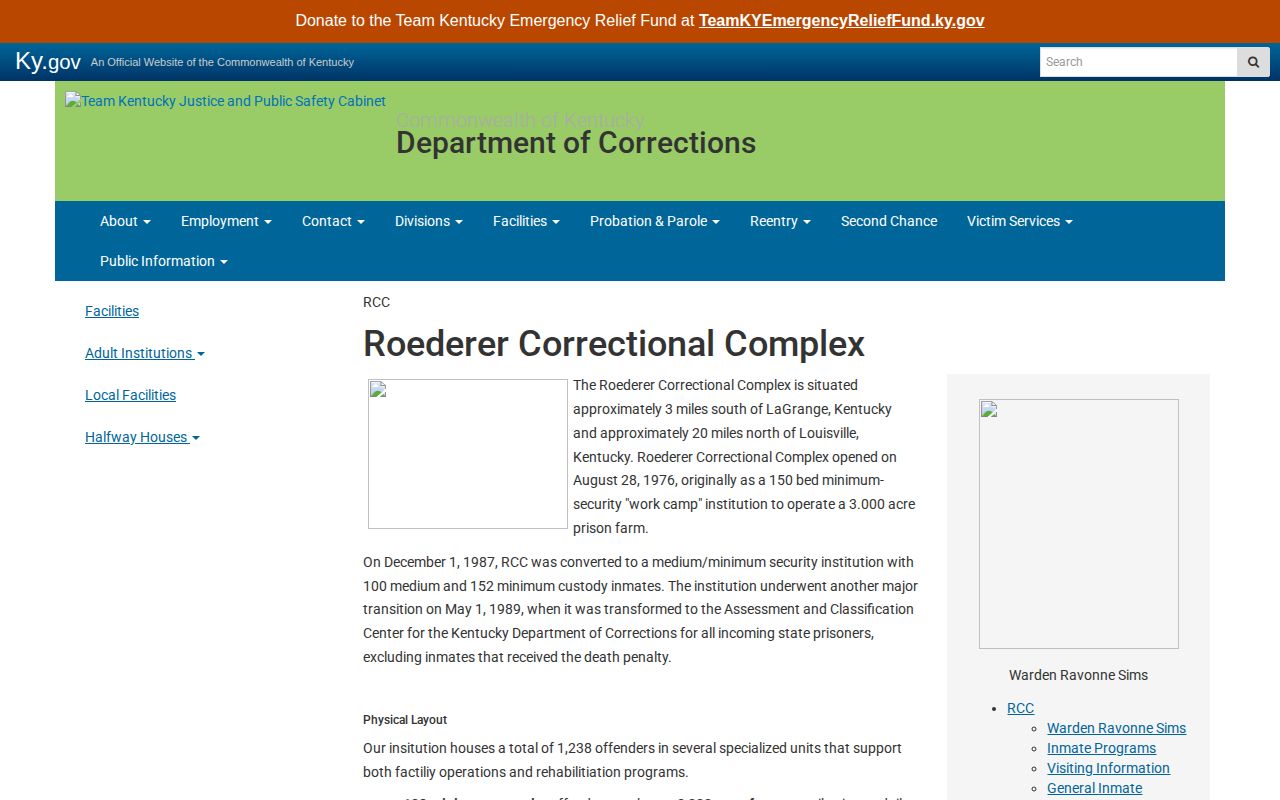
The captured page reinforces why a movement from RCC must be tested as a possible classification placement before it is called community release.
RCC Placement Record Checks
Classification transfer is best documented by reading KOOL over time or requesting a defined KOMS location history. A location history can show when RCC custody began and when the person was assigned elsewhere. The request should seek existing entries for a date range. DOC does not have to create a new explanation of why a placement decision was made.
If a Daily Releases row is found, compare its DOC number with KOOL and preserve the exact release phrase. “Discharged - Minimum/Detainer” warns that another custodian may follow. “Mandatory Reentry Supervision - In State” means community supervision. A simple change to another institution is still prison custody.
Oldham's local facility density makes the receiving name important. KSR, LLCC, and KCPC have different missions and, in KCPC's case, a different operating cabinet. Record the full institution name rather than using “La Grange facility” as shorthand.
RCC Dates During Assessment
A projected date displayed during a Roederer assessment remains a statewide sentence calculation, not a promise that release will occur from RCC. Placement can change before that date. The person may finish assessment and move to a permanent institution, where later custody and release events will be recorded under the new location.
Read minimum expiration, parole eligibility, and maximum expiration as separate fields. Minimum expiration reflects current qualifying credits. Parole eligibility is only a chance for consideration. Maximum expiration is the outer sentence date shown. Credits, discipline, new judgments, warrants, detainers, and parole action can change the path. A statutory violent-offender floor may apply only when the offense and sentence fall within its defined scope.
For a historic assessment stay, request KOMS status and location history for a narrow date range. Pair it with the sentence-calculation sheet and any release certificate. That record set can show whether RCC was merely the assessment stop, identify the permanent placement, and distinguish a later community release from the earlier classification transfer. The public screen should never be treated as a complete certified custody history.